Tuesday, 26 May 2015

Your ticket to ride.

It's that time of year again: Bike to Work Week is happening in cities everywhere. And finally, you're ready to give it a shot. You've thought about it long and hard, and this is it, you're going to give it a go. Wise choice!


Your body, your mind, your bank account, and your municipality will all thank you. And despite what you've undoubtedly heard other drivers say about cyclists, they will thank you, too, because you represent One Less Car on the roads in front of them. You're not willing to pay through the nose to park your car every day, and even with the price of oil scraping rock bottom, the price at the pumps is still exhorbitant. The cost of taking transit is not exactly easy on the pocket, either, and it leaves you at the mercy of outages, delays, and the occasional out and out fail. Once you've finally caught the bus you're hoping for, you're crammed into a tight space with a bunch of strangers and potential predators. What fun.

Mike McArthur via the CBC
And then you see those hipster kids out there on their bikes, smiling like they haven't a care in the world. It's not just kids, either. All sorts of people are riding these days, and if they can do it, so can you. And you're ready. It's time.

You probably have an old ten speed


or a mountain bike


sitting in the garage or in the basement. Drag it out. Pump up the tires, grease the chain and hop on. And before you take up the commuting challenge, give it a test run.  If you're really going to commit yourself to a new way of life, it's important that you're comfortable and well prepared, and naturally, it starts with what you're riding. 

The Guardian: In defense of MAMILS
You've surely seen a lot of middle aged men in lycra (M.A.M.I.L.s) out on the roads, specially during this time of year, and you've seen your fair share of mountain bikes out and about, too. Both of those types of bike has a specific purpose, and while they're ideally suited for the task at hand, they might not make the best commuting bike. But it isn't always necessary to spend a lot of money before you've given it a go. The most important thing to consider when you're planning to commute is your comfort. So dig the bike out of the garage or the basement, and give it a spin. Does it still fit you?

If you've an old mountain bike kicking about, it probably has knobby tires, which are ideally suited for climbing steep dirt trails, but they're noisy, and pretty heavy, too. That means that you will be spending more energy moving the bike than you have to. You might want to consider changing the wide, knobby tires on your mountian bike to a slimmer pair of slicks, to decrease your rolling resistance. Because why work any harder than you have to? 

And speaking of workloads: backpacks are the bane of easy commuting. There are a few items you will want to consider purchasing to simplify your ride, and chief amongst them is a rack, if your bike doesn't have it, along with a good bag. 


So many times I've heard people say "Oh I couldn't ride to work! I'd be too sweaty when I got there!" Two things: first of all, many buildings have a gym or a shower room for employees, but even if there isn't a shower available, you can always do a simple wipe down should you find your ride a vigorous one. And most people drive less than five kilometers, so after a few weeks, you won't even break out a sweat. But also (and second) leaving a little early and taking it easy on the way to the job will take the edge off. And packing your belongings into a bag instead of hauling them on your back will eliminate the soaked and sweaty back issue. Plus, and this is huge: backpacks will multiply your discomfort, especially if you've not ridden much for a good few years. Failing that, you can do what lovely Katie Poon (of I Fucking Love Fitness fame) does: haul your week's worth of clothes to work on Monday, and bring it all back again on Friday. That way, all but two of your ten rides that week will be comfortable. And it is a great strategy if you're riding a high end road bike which won't take a rack. But most bikes do, and many clever commuters take advantage of them.

A favourite: my waterproof laptop bag.
The other items you'll want are fenders, or at least you definitely will want them if you're a Vancouverite. And although a little fender over your back wheel will protect your butt fromt that tell-tale black stripe up your back, they do have several short comings. Soon as I started riding in a group in the off season, somebody politely requested that I get a set of courtesy fenders. That's a long fender with a mud flap attached at the end of it, so that the end of the flap is just a few inches off the ground. 

Bea Bike's rusty front fender and trusty mud flap.
The reason for this is that the water sprays up from the wheel much like a lovely rooster tail, and unless you're sporting a full fender and flap, that spray will end up in the eyes of whomsoever is directly behind you. And the faster you're moving, the harder and higher it sprays. The same is true of the front wheel, which means that if you're riding to work in a pair of shoes or some clothes you actually like when it starts to rain, then your front fender and mud flap will protect everything from the dirty water spraying up from the road.

Bell and folded Abus lock
You will of course want a lock. Do not rely on a cable lock, except perhaps to lock a nice saddle to your frame, (though even then, I prefer a bike chain.) No. Cable locks are an invitation to bike thieves. A U-lock is fairly effective, and the heftier it is, the more protection it provides. I like the Abus folding lock, cause it's sturdy, but not too weighty. Bea bike, the Amsterdam Royale already weighs sixty pounds before panniers, so every little bit helps.

And a simple, handy, and inexpensive addition to your cockpit is a bell. Some people just use their voices, calling out "On your left," as they approach another cyclist, or a pedestrian, to overtake them from behind. One well known local whistles a simple little riff instead. I love that, cause it's friendly, and effective - more so than shouting - and it's always well received. I would do it myself, except I can't really whistle, at least not well enough to get the job done!

One last thing before you set out: lights. You don't want to be out after dark without a decent set of lights on your bike.


It's summer now, or at least it is up here in the northern hemisphere (!) so you won't often need to use them, but it's still a good idea to have lights on hand. Some people ride with their lights switched on all of the time, (and those that do inevitably seem to have the front light permanently set to the worst possible epileptic strobe) but most of us just use them when the weather's inclement, or once the sun has gone down. But even if you rarely need them this time of year it's great to have them, just in case you want to catch the late show with friends.


K. So you're ready to rock'n'roll. You've given the bike a test ride, so you know it's tuned and running smoothly. You've got a rack, bag, fenders, lock, bell and lights and now all that's left is to give it a go. You've likely driven or taken transit to work for years, and so you know the way like the back of your hand, but sit might still be a good idea to take some time to test ride your route. The roads you've always chosen as the most efficient way to travel in a car are probably not the same, best choice for when you're on your bike.

There's a distinct subset of cyclists who don't like bicycle infrastructure, believing instead that since we're vehicles, we simply need to act like vehicles, and all will be well. While it's true that as vehicles we have every right to be on the road with all of the other vehicles, a cyclist doesn't have thousands of pounds of steel round them to protect them in the event of an accident, so we need to take extra precautions in order to stay safe.


Still. There may be times when you'll choose to ride with traffic on a road without cycle-specific infrastructure. When you do, it's important to be visible and predictable. You are entitled to half a lane wherever you are, and a motorist is obliged to give you a meter's clearance when they pass you.


Also, there are instances where you are entitled to take the entire lane. For example, if you are riding down a hill and are moving at the speed of traffic, it is better to take the lane than to ride too close to the edge of the road, where you have less room to manoever should you need to dodge something in the road. Motorists will generally give you as much room as you take for yourself. So if you are riding in traffic, make sure you ride a foot or two from the edge of the curb so that motorists will give you your half lane minimum when they pass. If you ride right on the very edge of the lane, motorists will be tempted to speed to overtake you within the lane, leaving you in a situation where you are in tight quarters at high speed - a recipe for disaster. So be confident and take your place on the road.

But more and more, there are alternatives to travelling in traffic. When you're planning your route, keep in mind the bike infrastructure in your area.  Most common, though at the same time, the least protective of the options are Bike Routes.


These are simply roads with bike pictures painted on the asphalt, and bike route signs posted along the way. Generally they also have reduced speed limits, though only a percentage of motorists actually abide by the limits. And it's not generally a large percentage of them, either. It's important that you remember to always give yourself three feet of distance from parked cars, too, because you don't want to win the door prize.


Most cyclists also drive, and so of course we don't want to annoy the drivers we are sharing the roads with. But if you do ride right beside parked cars in an effort to stay out of the flow of traffic, sooner or later you will be doored, and if you either swerve out into traffic to avoid hitting the door, or get thrown out into traffic by getting hit by the door, the end result is nasty. You do have the right to safe passage on the roads, and so don't be afraid to take the lane and stay out of the door zone, even if it means that traffic has to slow to go around you. But then, on a route like that, traffic is supposed to be moving slowly, for safety's sake, so don't cave to pressure to ride right next to parked cars to allow traffic to move faster. Motorists can always use thoroughfares if they need to speed. And they will. But more and more, a cyclist has options which give them the freedom to move safely, bypassing those busy streets.


The Burrard St bridge infrastructure was a long time coming, and even so, it was resoundley rejected the first time the city tried to install a bike lane on it. But we cyclists persisted in cycling, and the city eventually figured out how to accomodate us, so that now the bridge is the most used piece of bicycling infrastructure in the city.


And if you take a look online, you will find a route planning website which will allow you to make the best use of your city's cycling infrastructure.


We're lucky here in Vancouver to have some excellent infrastructure, with long routes of protected, separated bike lanes that allow a cyclist to travel safely through some of the busiest neighbourhoods in the city.


But it didn't just happen. It took a community of cyclists all determined to live a better lifestyle, and undaunted in the face of the loud opposition of people in denial of the unsustainability of the car-centric city. Chances are that wherever you are, your municipality has embraced cycling to some extent, because the benefits to the municipality of establishing that sort of infrastructure are well documented and undeniable. Get on it. Make use of it. Not only will your life look and feel better, but at the same time, you will be contributing to creating a beautiful, sustainable, liveable community. You'll glad you did.


Sunday, 17 May 2015

Our turn has come.

We're winning. There's a revolution going on, and no matter how you spin it, cyclists are bound to come out on top.
Metronews
Ask any motorist what they think of cyclists, and almost inevitably they will go on a tirade about how we are all law flouting maniacs responsible for chaos and mayhem on their well ordered streets. Rare is the driver who is even aware of the mistakes they make behind the wheel, errors which may result in life altering injuries for any cyclist unfortunate enough to be in their path. But don't bring it up, because sacred is their right to drive.

Metronews
And even though we are scorned, resented, and even sometimes hated  by ever so many motorists (self evident when you read the comments on any article about cycling in any publication), we are definitely on the right side of history. That's why cyclists can rest assured that a two wheeled way of life will be embraced by an ever growing number of people as time marches inexorably on. Our interests will be protected, even promoted by a growing number of governing bodies all over the globe. Here in Vancouver, where a progressive city council has embraced cycling infrastructure, despite the vociferous objections of many of the wealthiest, and thus most influential, people in town, the number of cyclists has dramatically increased in recent years. And that's a good thing, because along with the uptick in the number of cyclists comes a reduction in the number of automobiles congesting our city streets. And no matter how much you might hate me, dear motorist, you can't help but like seeing fewer cars on the road in front of you, and one more vacant parking spot when you do finally decide to stop.


Yep. It's a good thing that there are more and more of us on the roads. Why? OMG, can you imagine the gridlock if we continued to worship the motoring way of life the way we have for decades on end now? Vancouver is projected to grow by more than a million people over the next twenty five years. Already our streets are amongst the most congested in North America, and as we have a geography clearly defined and limited by both the mountains and the sea, that isn't about to change any time soon. There simply isn't the room for a million more cars. Crossing 16th Avenue on a Sunday morning is an exercise in patience, so don't bother even trying it in the middle of rush hour.

And here's the kicker: The British Columbia Ministry of Transportation readily spent $2.6 BILLION dollars building the new Port Mann Bridge. When it opened, it was the widest bridge in the world, with a whole ten lanes of trafic, and it was and remains the second longest cable stayed bridge in North America. The only problem is that it has done nothing to ease congestion in the city, except for in the area immediately preceeding the bridge. So far, the only thing this investment has accomplished is to move congestion from one side of the river to the other. It has also increased the traffic on the next crossing, the Pattullo Bridge, which was a nightmare even before people started using it to avoid paying the Port Mann toll. The Patullo was built in the 1930's, with very narrow lanes, and awkward approaches, and because the bridge was never built to handle today's big trucks, many of them need to take two lanes just to get onto the bridge. It's a mess. But don't worry, the Ministry of Transportation is willing to spend another billion dollars or so to build a bridge in New Westminister, too.

 The Now
Do you know what they're not prepared to do? They won't invest in transit. Nope. Nothing. De Nada. Zilch. Even though this government will happily drop billions of dollars to build bridges, (which only postpones the inevitable) it refuses to spend anything on sustainable development. What. A shocker. So the only way that residents of the Lower Mainland are going to see an improvement in the kinds of infrastructure which WILL create more liveable cities is if they pay for it themselves. That's right.
No spending on transit unless we the citizens vote yes on a referendum asking whether we will accept a 0.5% sales tax increase to fund the development.

 WTF? A 180 fork alignment!

It's all bass ackward. But then I expect very little from our government, what with its prioritization of the extraction and promotion of fossil fuels and its complete and utter lack of initiative when it comes to developing sustianable energy systems to see us into the future. No. This government is wedded to the past, with its prehistoric energy policies and will not budge till it, too, goes the way of the dinosaur. Our Premier, Christy Clark, is a bright little shadow of Stephen Harper, whom Pulitzer prize winning Chris Hedges recently declared a corporate puppet. And please, give me one shred of evidence that it isn't so. Each and every one of the grave mistakes made during the Bush administration, is happening here and now, in a Canada unrecognisable to those of us who like to think of our collective native land as the True North Strong and Free. The devolution of Canadian politics is happening at an alarming rate, with the underfunding of health care, the dismantling of social programs, the criminalization of poverty and the militarization of police forces all echoing and mirroring the decline of civilization in America. Let's not even mention the illegal war you'll find Canadian soldiers waging over in Syria. (Yes, of course ISIS is pure evil, but our being there with no end plan only strengthens their ability to recruit our youth.) And in the name of Homeland Security, the conservative government just passed bill C-51, laying waste to the Canadian Charter of Rights and Freedoms. Sigh. Where are the mass protests which ought to be happening in every city across the country??!

Yes, Hedges has a lot to say, in fact, but the biggest take away I got from listening to his interview on The Current this week is that America (and by extension Canada, too, with its corporation-serving administration) is in the grips of a protofacist movement dating back generations and gaining exponential strength today. Hedges goes even further. He says that America is on the road to revolution, and he incites us all to defiance and protest, claiming that we are morally obliged to stop our government (s) from continuing on this path of absolute unfettered domination and destruction.

Hear. Hear. He's right.

And guess what? You don't even have to take up arms to take back your country. The best thing about waging war on a corporatocracy is that the most powerful weapon of all is in your pocket. You use it every day. It's your wallet! Here in Vancouver, growing number of us are choosing not to buy in to the bullshit. You don't actually NEED to drive everywhere you go, despite what you've been taught to believe. Do you wanna to know why I call it the bike path to world peace?


It's simple. When you ride where you need to go, rather than drive, you're happy. Endorphins, serotonin, dopamine? Those are your brain's happy drugs, and they're yours for the making when you choose two wheels over four. So you're happy, and suddenly you're healthy, too, because all of that movement boosts your immune system and your sex drive, and actually slows the ageing process. (Does that look like a woman approaching the half way mark? I will turn 50 next year, but bikes keep me young and if it works for me, it will work for you.) And cycling does wonders for your legs, too, not to mention your butt. So. You're happy healthy, and hot, and suddenly you've got more money in your pocket, too, cause you're not donating it to the oil and gas industry, (already in receipt of unbelievable subsidies, so you can feel good about it on every level). If that's not a recipe for love, please tell me what is! Suddenly, you've got a great sex life going on, et voila. Your happy, healthy brain is saturated with oxytocin, the brain's love drug. What does that mean? It means that you see people as more loving and trustworthy, and concurrently you act in a more loving and trustworthy way. You see where this is going, don't you? If everyone rode a bike when and where they could, we'd be enjoying world peace in no time.


Quick. Somebody buy our leaders a bike, so we won't have to hold any more silly referendums to fund what ought to come natually to us all. Of course there will always be a time and a place for cars, and a good reason to drive here and there, but the daily commute isn't it. Sustainable cities - you know, places where people live and work in the same community, and where everything needed for daily living is close at hand? It's the way of the future, no doubt about it. Whether our governments see the truth of their own volition - or whether we need to be firm in our resistance - is yet to be seen, but here in Vancouver, at least, there's a beautiful, soft light at the end of the tunnel. The revolution has begun.

Monday, 4 May 2015

May the Fourth Be With You.

You could be forgiven for thinking that summer had arrived in Vancouver. The snow is all gone, and the beach volleyballers are volleyballing on the beach. Oh wait! We never had any snow this year.


But wait again! Now that the nets are up, now that spring is well past sprung and now that the ski slopes are long closed? Yeah, NOW there's snow on them there hills.


You see that right there? That's whatchacall the contrary nature of life. And the signs of life are everywhere. The bears have come out of hibernation up in the mountains, and have come to town to visit, so you know that winter is well and truly over. The humans have come out to play, too. You'll find the signs of the season everywhere.


Longboards that were long languishing in condo closets are now prominently present on the promenade.


And all of the vacuous vehicles are out on proud display. The owner of this baby might easily have been the guy who offered to buy the Shaugnessy mansion at list price to store his car collection.


Though I don't think much of his taste in vehicles, you've gotta give him points for matching his shoes to his ride.


And speaking of scoring points... a few people were playing croquet on the lawn, and they had the balls to offer me a drink to join them in their game. How wicket! 


Just a little way away, another group of people tried to rope me into joining them. I TOLD them I'm not a well balanced person, but they were having none of it.

If anyone needed a helmet in a situation like this...
"Just toe the line," they said. "Try and be modest, because pride comes before a fall, you know." 


Ha!  Lol!! And don't I know it! Can you think of anyone who's had more experience with falling, except maybe that guy in the seventies... what was his name again? Evel Knievel. Despite all of his falls and mishaps, though, that man had a lot more going on in his head than me, cause he managed to get paid for his efforts, whereas I simply appear to be dain bramaged.


It doesn't take a lot of reflection to see that beautiful weather means that everybody's out doing the things they love most...


Naturally. Some of us enjoy our favourite pursuits year round, and while some pursuits are winter specific, many outdoor activities are for fairweather Freds.


I am committed to riding my bikes year round, because the correlation between activity and happiness is painfully obvious to me, but most people don't see it the same way, and so you will notice an explosion in the number of bikes out and about this time of year. 


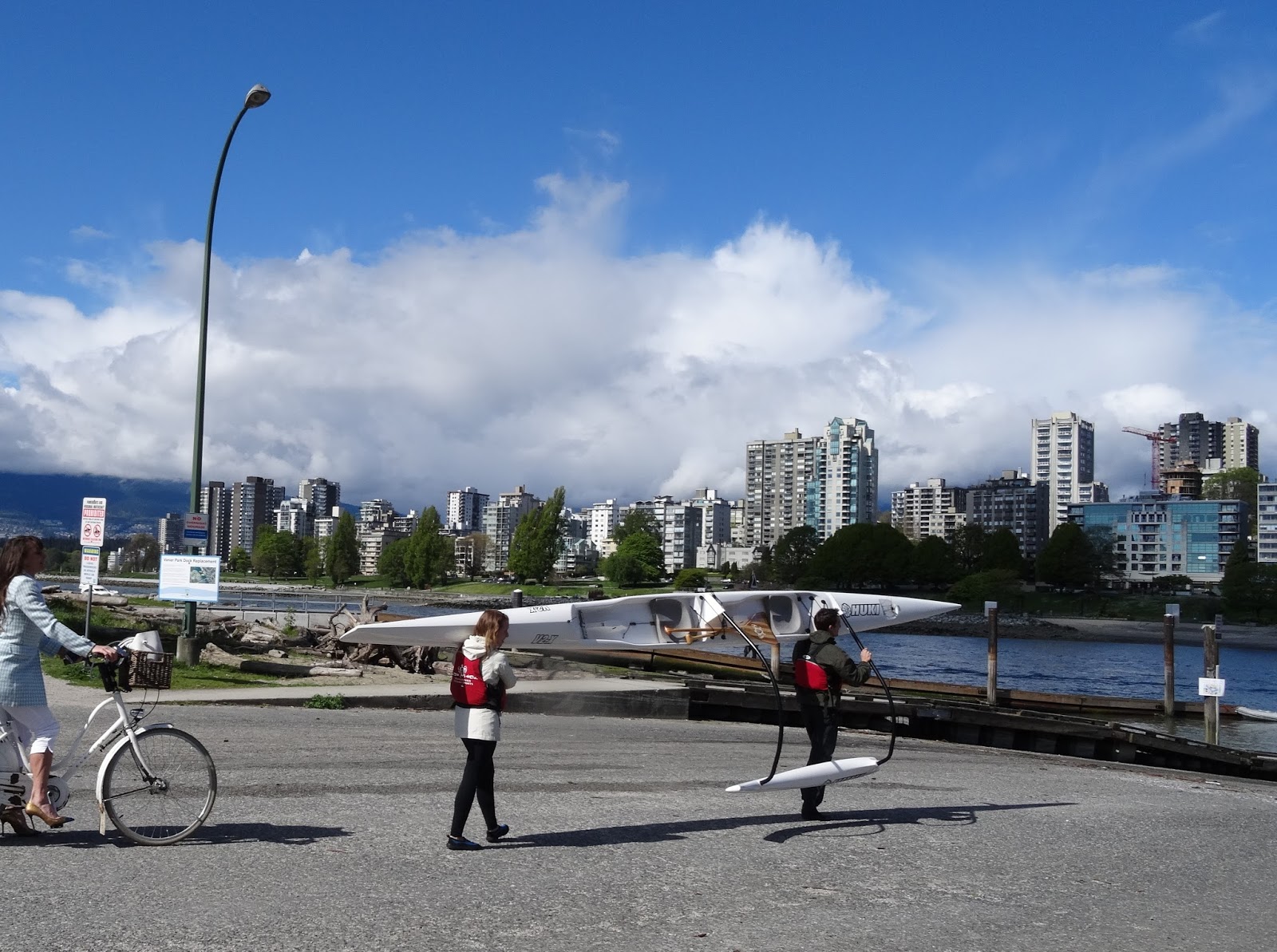
And for many people, bad weather makes pursuing their passions impossible. After all, the Inuit might enjoy a paddle in icy cold waters, but most people prefer to have feeling in their limbs. But now, with the warm sunshine's arrival, the outrigger canoes and the dragonboats are freed from their winter hiatus.


Let's face it.


It might not be strip-down-to-your-bikini-and-sit-on-the-beach weather just yet, but the signs of the season are everywhere. It's funny. No matter how happy you might be to see the days shorten toward the holidays, that's a feeling that quickly wears off, because everybody loves a warm, sunny day.


Wouldn't it be lovely if every day were ripe with the promise of an endless summer in front of you? Don't scoff, but anything's possible, you know. Canada has just created its first "Dementia Village" based on the Hogewey project in Holland, where dementia patients live in a true to life fantasyland, a protected, sheltered, staged small town which simulates ordinary life, even as it keeps them safe and contained.  I want to live there now!

If I lived in a dementia village, I might be able to forget the truth, which is easily and conveniently summed up thus: 


And upon further reflection, there is no-where I would rather be than with my head firmly buried in the sand. Between the wholesale destruction of our natural world, and the criminal undertakings propping up the global financial arena, this particular Monday the Fourth of May is a dark day indeed, despite the bright sunshine and the approaching summer season.

ER... did that statue just exhale?!
But maybe you can see a light at the end of the tunnel - maybe you know something which has completely eluded me...? Is there a solution to the crisis fast approaching which my poor, addled brain has completely missed? If so, please do let me know. In the mean time, I need to seek some peace of mind, so you'll find me on my bike, pedalling my way to a place of serenity, and praying for an answer.

May the Fourth Be With you, dear friends, because sooner than later, we're all going to need it.

Monday, 20 April 2015

Snake oil and bunker oil... something's mighty fishy in English Bay these days.

Vancouver has a jaw-droppingly beautiful harbour. Despite being the fourth largest port on the continent, it's home to killer whales, grey whales, harbour seals, sea otters, a multitude of fish and birds, and of course, the exotic, blue-tinged polar bear swimmer.


It's a powerful place. It's teeming with life because it's here that the continent meets the Pacific, but it's also where the natural world collides with the industrial. 


It's a relationship with an historically one-sided outcome; after all, how often does nature triumph over industry?


Industry enjoyed a slam dunk here quite recently. There are seventeen moorages in English Bay, deep water parking spaces for ships awaiting their day at port. Last week a brand spanking new grain ship on its maiden mission was awaiting its turn in the harbour and inexplicably fouled the waters when it lost many thousand litres of bunker oil. A recreational boater in English Bay alerted the authorities at 5:00 pm on Thursday, the 9th of April, but even though he waited for hours for the coast guard to arrive, he didn't see anyone. No one placed a boom around the leaking Marathasa until midnight. 


According to the Bellingham Harbour master, the alarm wasn't even sounded till 8:00 pm, and it took them another four hours after that to get a boom around the vessel. That's seven hours from the call. Worse, it was sixteen hours before anyone alerted the city to the spill, so the first anyone in Vancouver heard of it was the next morning. You might wonder how it could take so long to respond to a spill in such a busy urban centre, but the nearest Coast Guard station is down next to the airport at Sea Island in Richmond, where the Fraser River meets the Georgia Strait, over ten kilometres away. The closest boom ship is in Port Moody, in the opposite direction. You'd think that a busy port like Vancouver would have a Coast Guard, wouldn't you? It certainly used to. With the abysmal response to this spill, a chorus cried "I told you so!" Why? Two years ago, the Feds closed the Kitsilano Coast Guard station, the busiest in the country.


Incredibly, the Coast Guard commissioner in Ottawa claimed that the response to this spill was "world class," and insisted that an open and operating Kitsilano coast guard station wouldn't have made any difference whatsoever. But then federal employees are not allowed to speak truth, didn't you know? You might think I am being facetious, but sadly, no. It isn't just our federal scientists who've been silenced, and scripted. There is a "Code of Conduct" which emphasises a "Duty of Loyalty" to the "Duly Elected Government," which includes both a muzzle and a snitch line. Any. Federal. Employee. And this code of conduct extends beyond the workplace to the employees' personal lives. They are not allowed to speak out against any aspect of the federal government. End. Of. Story.  Can you believe it?! This is Canada, not North Korea, though you'd never know it. So of course the commissioner would say that this was a world class response. She was obliged -required by law - to lie, and to claim that nothing would have been any different had the station been open.

Take a gander out the window of the closed station and you could have seen the offending ship.
I know a man, a federal investigator who is regularly called upon by the media, and he constantly struggles with that mad "Code of Conduct." He has a reputation for integrity decades in the making, only now the federal government demands he tow the line with heavily scripted propaganda he feels morally compelled to edit from his statements. In doing so, he walks a fine line, lest he invoke the "Ire of Harper." Was there ever any question, then, that the commissioner should made clearly and obviously false statements? The size of the spill was understated. And within a day or two, the feds claimed that  "The lion's share" of the oil was already removed from our waters, which is impossible, not just unlikely. They claimed that 80% of the spill was removed within a few days, when even an excellent, truthfully world class response would have amounted to a 30% removal. Assistant commissioner Roger Girouard actually  had the gall to claim that "Just six litres of oil remained in English bay by Friday!" Six litres. As. If. What an insult to our collective intelligence.


Six. Litres. He knew this because somebody flew a float plane over the bay. They hadn't even looked underneath the surface at that point. This is bunker fuel. Heavy, sludgy bunker fuel, which does, in fact, sink, by the way. Never mind the bathtub ring round the harbour, and the boats all around the region coated in oil. But he insists that we should take their word for it. He insists that this was a world class response to a small spill, and that there are only six litres of oil left floating around out there. We should happily embrace pipelines and the tanker traffic that goes with them, because they have the best possible spill response firmly in hand. Fer fucksake. I am not sure what is worse, that our government is content to so blatantly lie to us, or that we complacent Canadians are happy to bend over and take it, and then keep on taking it, even as the shit they're shovelling is getting WAY out of hand.  My dear fellow citizens, please tell me: Why, Oh Why don't we hold the federal government accountable for its responsibilities?! Why don't we force them to do the things they are legally, ethically, and morally bound to do? Why don't we have this administration recalled?

Come ON, People!! It's well past time to give those nasty,  greedy leaders THE BOOT!
Why DO they continue to get away with such criminal behaviour? Spin. They can spin a better yarn than the best bullshitters, and that's what they do. The conservative government has world class spin doctors at their beck and call, and they had their top notch public relations team working on this spill long before any oil spill response experts made their way to English Bay. Seriously. Their oil spill experts were in Prince Rupert until two days after the spill occurred. The federal mouthpiece, Coast Guard commissioner Jody Thomas said that the Kits station was mainly a search and rescue operation, and therefore that it wouldn't have made a different to this emergency. She claims that the spill response was excellent, and that only negligible amounts of the toxins are remaining in our waters. 

Get a grip, people. We have a right to the truth, and to a healthy, living planet, too.
And it's LIES. All LIES. Captain Tony Toxopeus, retired Kits Coast Guard coxswain, said that his teams would have been on scene between six and fifteen minutes after the sailor's call at five pm. The mouthpiece said that it wouldn't have made a difference to the cleanup, because Kits was mainly a search and rescue facility, but she failed to mention that the Kitsilano station was, in fact, where the coast guard trained its people in spill response. Toxopeus said "the base was equipped with a purpose-built oil pollution response vessel, 300 metres of self-inflating boom and other equipment. Crews were trained regularly to deal with oil spill response."  Unlike the Ottawa based commissioner, Captain Toxopeus knows exactly what he is talking about, because he participated in hundreds of spill response calls. He isn't just reciting a government sanctioned press release, a script designed to make the government look good in the eyes of the less than discriminating Canadian target er, citizen. And the good Captain most certainly knows enough to know that the likelyhood that the brutally slow and inefficient response to that nasty little spill most definitely did NOT contain and remove 80% of the bunker fuel that entered the waters of English Bay.

It's nasty stuff, bunker fuel. Seriously toxic.
Do you know who else knows the score when it comes to spill response? Retired Commander Frederick E Moxley, that's who. Moxley, a 35 year Coast Guard veteran, and former Commander of the Kitsilano Coast Guard station knows what he's talking about, because he has literally responded to hundreds of oil spill calls,and has trained countless men in spill response. 

“I’ve been in hundreds of spills and never seen an 80 per cent recovery," Moxey said. "Usually you recover 30 per cent at most, more like 10, and that’s with an immediate response and a trained crew with sponges and straw pulling the oil out by hand.” Moxley is not the only person to suggest that the government is not speaking the truth, the whole truth and nothing but the truth, but his objections ought to be given more than a little credence, because nobody knows the facts in this situation better than he does.


Jody Thomas said: the closed facility has been used for storage after the spill, but said having the Kitsilano station open would not have made any difference in the spill response. Moxey contradicted this, stating that the Kitsilano base responded to oil spills as well as search and rescue before it was shut down. "It was a 24-hour-a-day operation," he said. "All the officers and crew at Kitsilano were trained and had responded to oil spills as well as search and rescue. For her to say that is just false and I will sign an affidavit declaring the fact we were and had been called to respond to spills often."

As Canadians, we shouldn't have to wonder whether our leaders are lying. But then we don't have to wonder, really, do we? it's patently obvious that they are. You can almost count on the fact that this administration will say whatever best suits its purpose, truth be damned. As citizens of a vast, resource rich nation, we have a responsibility to take our stewardship of this country seriously, and yet this particular administration is stripping the land of its riches, and putting the profit in the pockets of a very few individuals.many of whom are not even Canadian. 

It's time to put your foot down.
For example, Kinder Morgan is planning to expand their Trans Mountain pipeline from Edmonton to the Vancouver port. They want to twin it. The National Energy Board used to hear from anyone with questions, concerns or comments about these sorts of projects prior to making a decision about whether or not to let it proceed, but Mr Harper put an end to that. The hearings are now closed to everyone but those with a direct stake in the plan on the table. Still. The cities of Vancouver and Burnaby posed some 1200 questions to Kinder Morgan about their plan, especially with respect to their spill response. The National Energy Board was satisfied with Kinder Morgan's heavily redacted response, even though it did not even begin to address a realistic spill scenario, and even though the company refused to answer half of the questions the cities posed. Oh, but if anything bad ever did happen to our coastline, at least Texas billionaire Mr Rich Kinder could afford to represent himself in court. He took home $60,000,000 last year.

Trans Am Totem: becasue Car is King
You heard it here last week, though it's painfully obvious across the planet... something is rotten in the country of Canada, Horatio.  It's not just the toxins in the water, either.


The earning inequality between executives and the rest of the working population is staggering, and it's laying waste to the economy. But nobody has an appetite for change, it seems. Well, almost no one. There is a twenty first century hero amongst us, a Robin Hood for the modern age, except that this man is sacrificing his own bottom line to ensure that his employees have everything they need. His name? Dan Price. You 're not likely to forget it, either, because though he was already cover worthy, he is sure to get some serious air time in the weeks and months to come.

The Price is right! (photo courtesy YPO)
He started his company, Gravity Payments, as a freshman at Seattle Pacific, after learning that small businesses paid as much as five percent to credit card companies just to process their payments. He built the company throughout his education until last year when it realised a $2.2 million dollar profit, as he earned a million dollars. Over the years since founding the company, he noticed that he had two groups of friends: the wealthy executives, and everybody else, and what he saw bothered him.
“I was just experiencing the difference, and seeing both sides of that every day,” he said. The stark divide between the haves and the have-nots irked him, and he felt that the pay-gap between himself and his employees was just too much.
One day, while hiking with a friend, she confided about the stress of having her rent hiked.
“That was the straw that broke the camel’s back.”
About 30 employees will have their salary double, with others getting smaller raises to get them to the $70,000-benchmark. Before the increase, the average salary at Gravity Payments was $48,000, and about 50 employees were already paid above the cut-off, Price said. (From The Star)
He cut his salary to $70,000, and cut into the company's profits, too, to pay for the initiative, but he sees it as an investment. 
Price said the salary cut is just temporary, until the company makes back the profit lost to the higher wages.
“I think the team is going to do a great job and make that up,” he said.
“This is an investment, not charity, and it isn’t any more than what these folks deserve.”
Although he wants to pay employees well, he said it’s also important to pay a CEO a market rate, so that if something were to happen to him, the company could afford to hire his replacement.
“I’m a capitalist,” he said.
Price said he’s been overwhelmed by emails of support from other businesses. He’s especially grateful for the support from his customers, who have applauded the move.
“We’ve literally had hundreds of businesses reach out to us and say that they’d like to do business with us,” he said.
“I think this is going to become a competitive imperative over time, and it will catch on.”
Genius. That's whatchacall Visionary. It's exactly the kind of thinking that will prevent our descent into chaos should the present levels of income disparity continue to grow.